
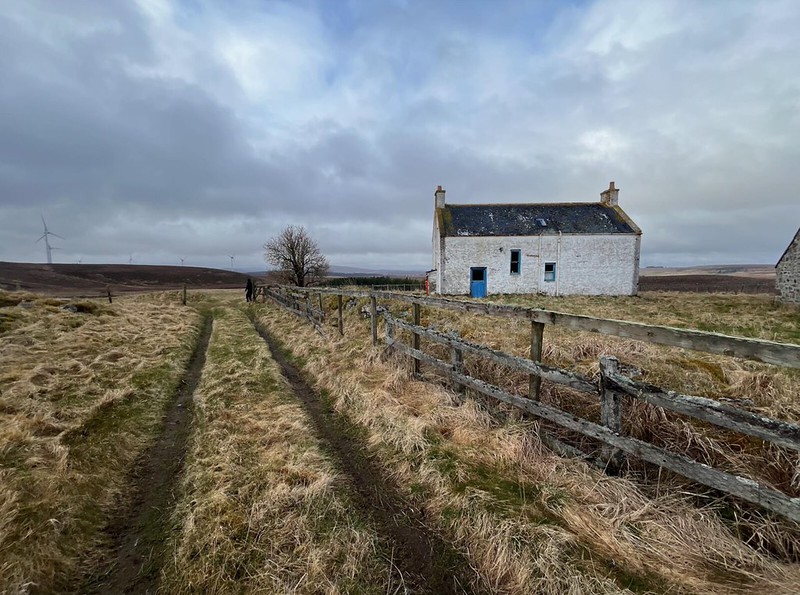
Rochlun
'A Golden Thread'
Deadline
February 13, 2026
Value
Funded
Location
Glasgow / Highlands & Islands Campus
Contact
dfa@gsa.ac.uk
'A Golden Thread' is a Scotland-wide programme of doctoral research training and enterprise development support, led by GSA Rural Lab in partnership with The Open University and Scotland's Rural College (SRUC).
The overall, seven-year programme (2026-33) will provide cross-institutional training for twenty doctoral students. Six places are available through this first cohort, which will start in October 2026. A six-week induction to the programme, focussed on self-care and preparation for study, will take place over summer 2026 (July/August). The programme includes an optional industry placement, post-completion.
Four students in this first cohort will register with the GSA and two will register with The Open University, with SRUC providing co-supervision for appropriate areas of study.
Applications for October 2026 entry are now closed. The next round of recruitment will be announced later in the year.
Key Research Themes
Craft is a key theme for the programme, and all proposals should demonstrate a strong Craft foundation or focus. We welcome proposals from applicants who identify as having a Craft practice (including, but not limited to materials, textiles, ceramics and printmaking) and who work in or across artistic disciplines (including, but not limited to visual arts, design and sound). Proposals are welcome for PhD by practice or by thesis. Candidates are encouraged to shape Craft-led research proposals at the intersection of themes/disciplines traditionally understood as from within the arts and humanities, and those traditionally understood as from within the sciences. These might include, but are not limited to:
- Biomaterials and regenerative design
- Planetary and space sciences, astrophysics and cosmology
- Agriculture, aquaculture, animal sciences and animalcare
- Environmental sciences and nature-based solutions
- Al and emerging technologies
- Rural geography, sociology and/or economies
Candidates should preferably be resident in and/or have a demonstrable personal, heritage or practice-led connection to Scotland's rural and island communities.
Find out more
Supervisory teams will be cross-institutional, bringing world-class expertise from across disciplines and partner institutions together to best service the needs of individual themes and topics of study. Applicants will register at either the GSA or the Open University, depending on which institution would be best place to support the proposed project. Potential applicants will be advised on best fit and on any institution-specific application requirements.
Funding Arrangements
The GSA and its academic partners are joined in the programme consortium by a national network of arts, cultural and community partners, including the Bernat Klein Foundation, The Crichton Trust, Skyeskyns, Fyne Futures, Shetland Arts Development Agency and Moray Arts Development Engagment (M:ADE). The programme is supported at a strategic level by Highlands & Islands Enterprise (HIE) and South of Scotland Enterprise.
Application Process
Applications for October 2026 entry are now closed. The next round of applications will be announced later in the year.
Eligibility
Applicants for PhD research at the GSA should normally have obtained a minimum of an undergraduate degree with First or Upper Second Class Honours and (where required) and English Language IELTS score of 6.5 overall with no less than 6.5 in each component (or equivalent). Application are welcomed from candidates with lived experience of marginalisation and/or who face systemic and structural barriers to doctoral study. Professional and lived experience will be considered in addition to, or as an alternative to prior learning.
'A Goldent Thread' is designed to address underrepresentation and marginalisation in Scotland's doctoral college and the wider creative economy, with specific reference to the geographic marginalisation which can be faced by residents of rural and island communities. Candidates should preferably be resident in and/or have a demonstrable personal, heritage or practice-led connection to Scotland's rural and island communiities.
Get in touch?

.png)

